Build Structured SEO Content Frameworks
If you’ve ever published a well-written blog post that just didn’t rank, the culprit is usually structure, not quality. Google doesn’t just read your words; it maps the relationships between your headings, sections, and topics to decide whether your content deserves a top spot. A random collection of paragraphs, no matter how polished, rarely beats a page that’s been deliberately architected around search intent. That’s the problem a good blog outline solves before you write a single sentence of body copy.
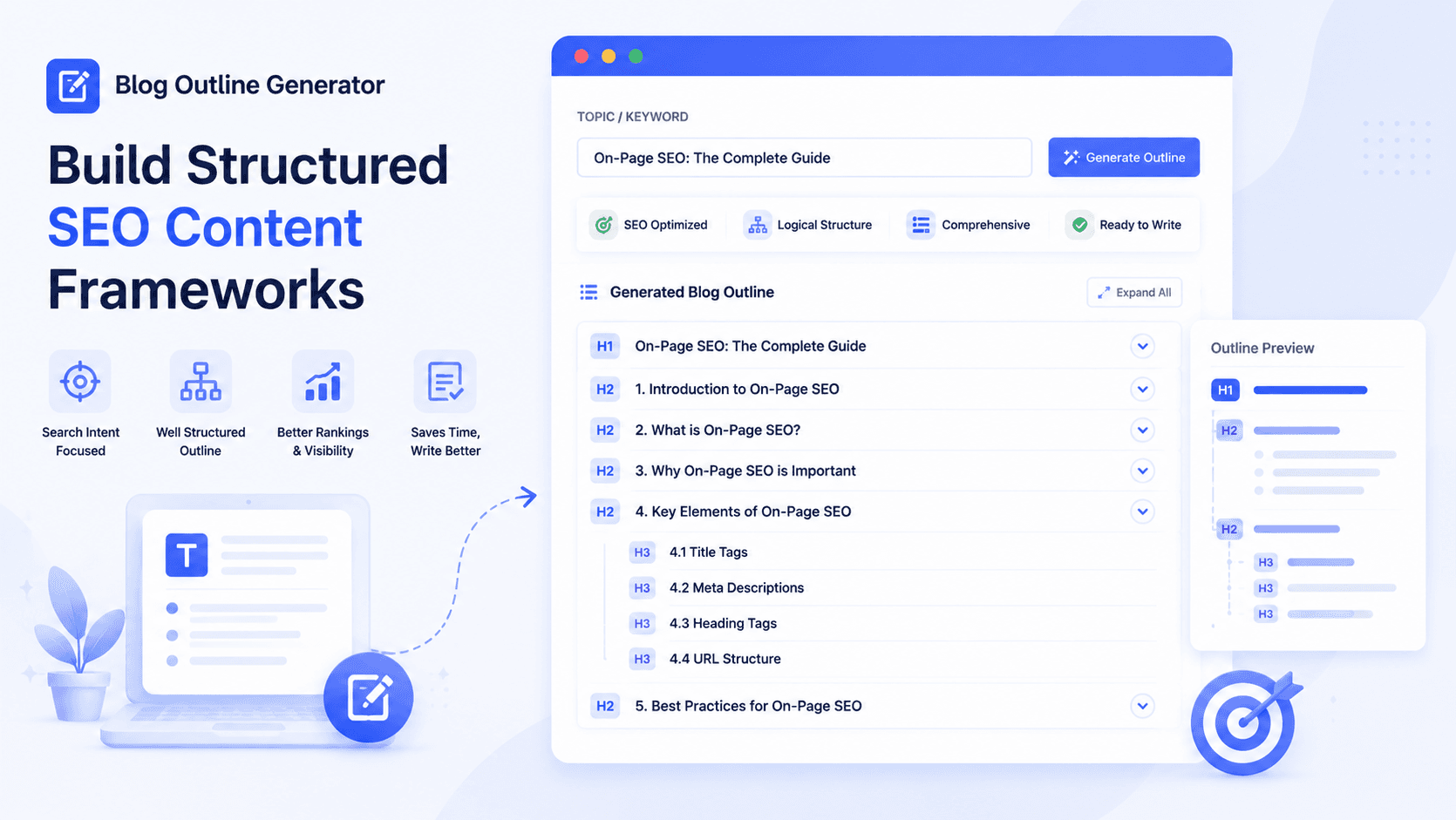
Enter the blog topic or title you want an outline for.
Definition
“An AI blog outline generator is a tool that uses artificial intelligence to produce a structured, heading-by-heading content framework for any blog topic, organized around search intent, semantic relevance, and topical depth. It maps your H1 through H3 hierarchy before you write a single word, ensuring every section serves a deliberate SEO and reader purpose.”
What Is a Blog Outline Generator?
Instead of staring at a blank document, figuring out what H2 comes after your intro, you get a ready-made skeleton: the right sections in the right order, with subtopics and supporting angles already mapped out. Growmatix’s free AI blog outline generator takes your topic as input and outputs an SEO-ready content framework in seconds; one you can hand to a writer, feed to an AI content tool, or build on yourself.
The key distinction from a basic template: AI-generated outlines are built around your specific topic, not a generic “intro, body, conclusion” placeholder. That specificity is what makes them useful for actual rankings.
Why Structured Blog Outlines Rank Better
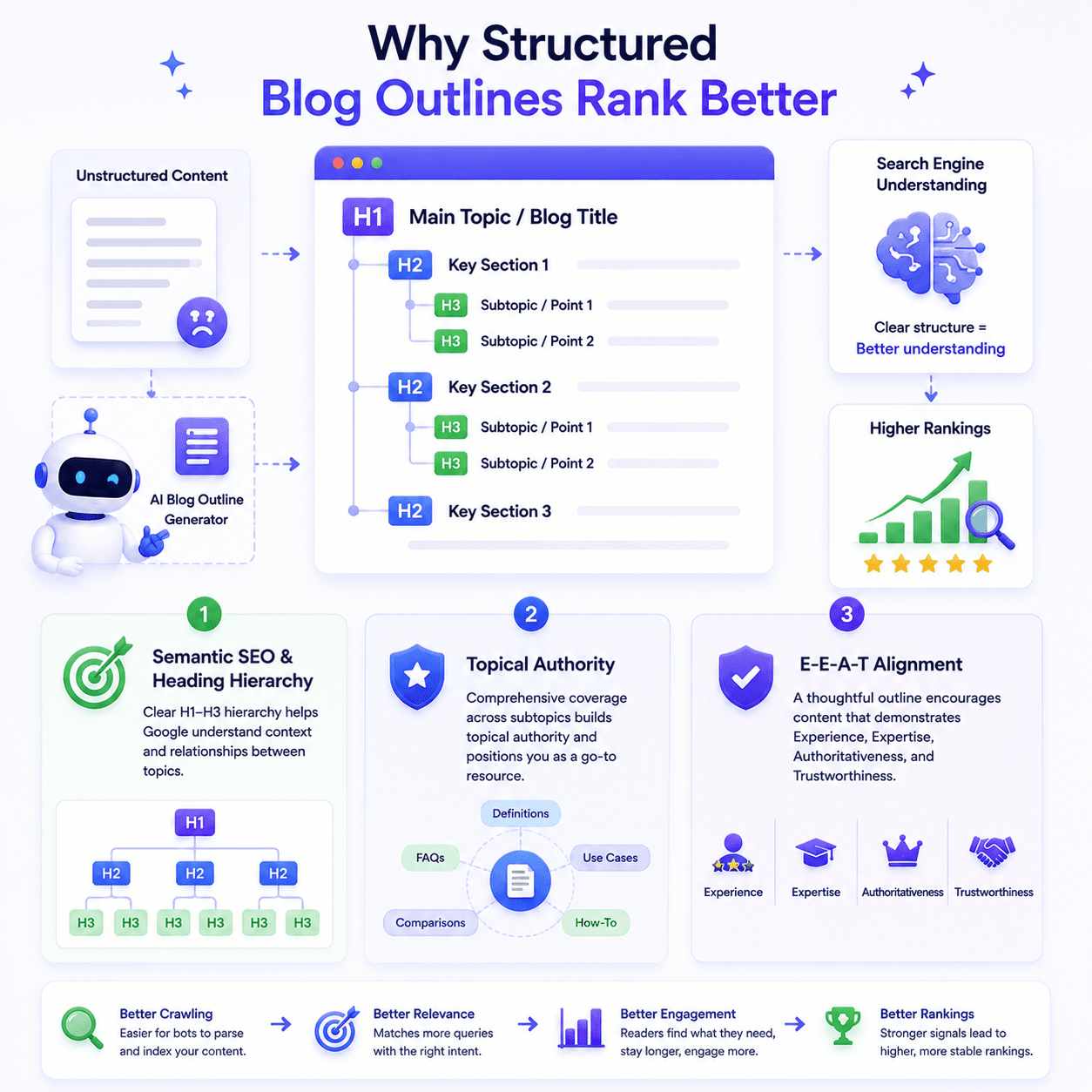
Structure isn’t just a readability nicety, it’s a direct ranking signal in several important ways.
Semantic SEO and heading hierarchy
Google’s understanding of content has evolved well past keyword matching. It reads the relationship between your H1, H2s, and H3s to build a topical map of your page. When your headings form a coherent, logically nested structure, it’s significantly easier for crawlers to classify your content and match it to relevant queries.
Topical authority
A well-structured outline naturally covers a topic’s full breadth: definitions, use cases, how-tos, comparisons, and FAQs. This comprehensive coverage is what builds topical authority- the signal that tells Google your site is a reliable, in-depth resource on a subject rather than a surface-level post fishing for traffic. Using our blog structure tool as part of a broader topic cluster strategy helps you build that authority systematically across multiple pages, not just one.
E-E-A-T alignment
Google’s quality rater guidelines reward content that demonstrates Experience, Expertise, Authoritativeness, and Trustworthiness. A thoughtful outline, one that includes original insights, supports claims, and anticipates follow-up questions, naturally encourages the kind of writing that scores well on these dimensions. The structure creates the scaffolding; good writing fills it in.
How to Generate a Blog Outline in 3 Steps
Using the tool is deliberately fast. Here’s the workflow:
Be specific. “Email marketing” will produce a generic framework. “Email marketing automation for B2B SaaS companies” will produce something you can actually use. The more context you give the AI, the more targeted the output.
The tool produces a full heading structure, H1 through H3, along with suggested section content angles and logical sequencing. Read through it critically. Adjust anything that feels off or doesn’t match your brand’s angle.
Add your internal links and keywords, layer in your specific data points or client examples, and assign sections to writers. The outline becomes your editorial brief. Writers know exactly what to cover and in what order, no scope creep, no missing sections.
Ideal SEO Blog Structure
Here’s what a strong, SEO-optimized blog post structure looks like in practice. This format consistently performs well across informational and commercial-intent queries:
H1: Target keyword + clear value promise
One sentence that tells both the reader and Google exactly what this page delivers.
Intro paragraph (no heading)
Hook, context, and a clear statement of what the reader will learn. Avoid burying the lede. Google often pulls intro text for AI Overviews; make the first 100 words count.
H2: Definition / ‘What is X’
Establishes topical authority and targets the definitional query variation. Great for featured snippet capture.
H2: Core concept or problem being solved
The ‘why this matters’ section. Semantic depth lives here.
H2: Step-by-step or how-to section
Targets ‘how to’ query variants. Numbered structure improves rich result eligibility.
H2: Examples, use cases, or comparisons
Adds specificity and E-E-A-T. Real examples outperform generic claims every time.
H2: Common mistakes or what to avoid
High-engagement section that reduces bounce and adds long-tail coverage.
H2: FAQ block
Pair with our AI FAQs Generator to create schema-ready Q&A content that earns rich snippets alongside your post.
Conclusion + CTA
Summarize the key takeaway, then direct the reader to the next action.
How to Build Topic Clusters Using AI Outlines
A single well-structured post is good. A network of semantically connected posts is what actually moves the needle on domain authority and organic traffic over time. AI outlines are a natural fit for cluster-based content planning.
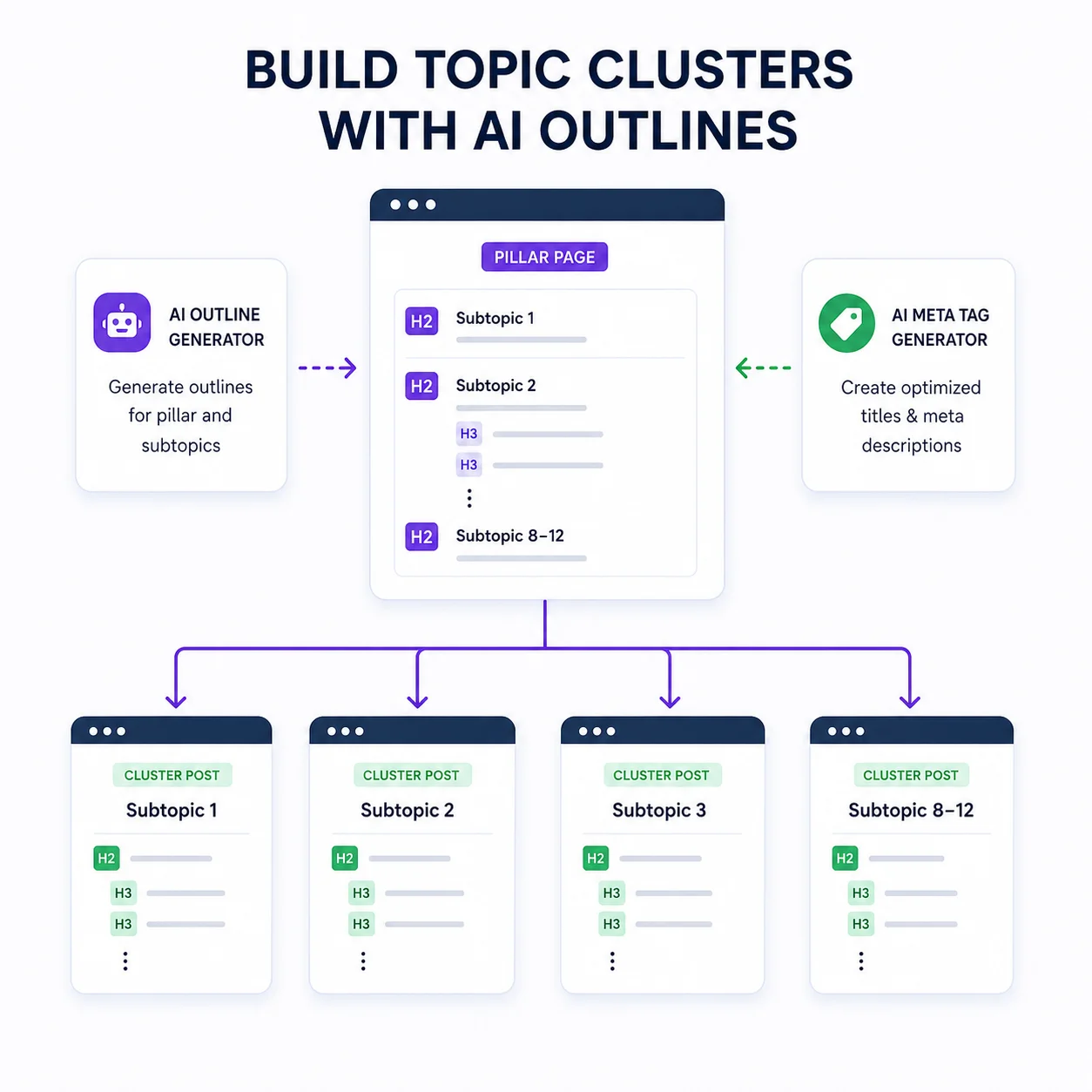
Here’s the practical workflow: start by generating an outline for your pillar page, typically a broad, high-volume topic that you want to own. The outline will surface 8-12 subtopics in its H2 and H3 structure. Each of those subtopics is a candidate for its own supporting cluster post. Generate individual outlines for each one, link them back to the pillar, and link the pillar forward to the clusters.
This approach does two things simultaneously. It creates an internal linking architecture that distributes PageRank across your content ecosystem. And it demonstrates to Google that your site covers a topic exhaustively, which is the clearest signal of topical authority that exists in modern SEO.
Combining the AI blog outline generator with the AI Meta Tag Generator means your cluster posts are structured and have optimized metadata from day one, two of the highest-impact on-page factors handled before a writer types a word.
Use Cases for Agencies, SaaS & Local SEO
The content outline generator isn’t a one-size-fits-all tool, it adapts to different content strategies depending on who’s using it.
For SEO agencies
It’s one of the most practical content marketing tools in a modern agency stack. Instead of a strategist spending 45 minutes building a content brief for every client post, the AI produces a structured draft in under a minute.
For SaaS companies
It’s particularly powerful for building out bottom-of-funnel content. Product comparison posts, integration guides, and use-case pages all follow predictable structural patterns that the tool handles well.
For local SEO
Structured blog content is an underused advantage. Location-specific how-to posts, neighborhood guides, and service explainers benefit enormously from proper heading hierarchy.
For bloggers and founders building personal brands
The tool removes the “I don’t know where to start” barrier that kills publishing consistency. A ready-made framework makes it dramatically easier to sit down and write.
Conclusion
Build Content That’s Engineered to Rank.
Most content fails not because it’s badly written, but because it was never properly planned. A strong outline is the difference between a post that ranks on page one in three months and one that sits on page four indefinitely. The structure you set before you write determines how Google classifies what you publish.
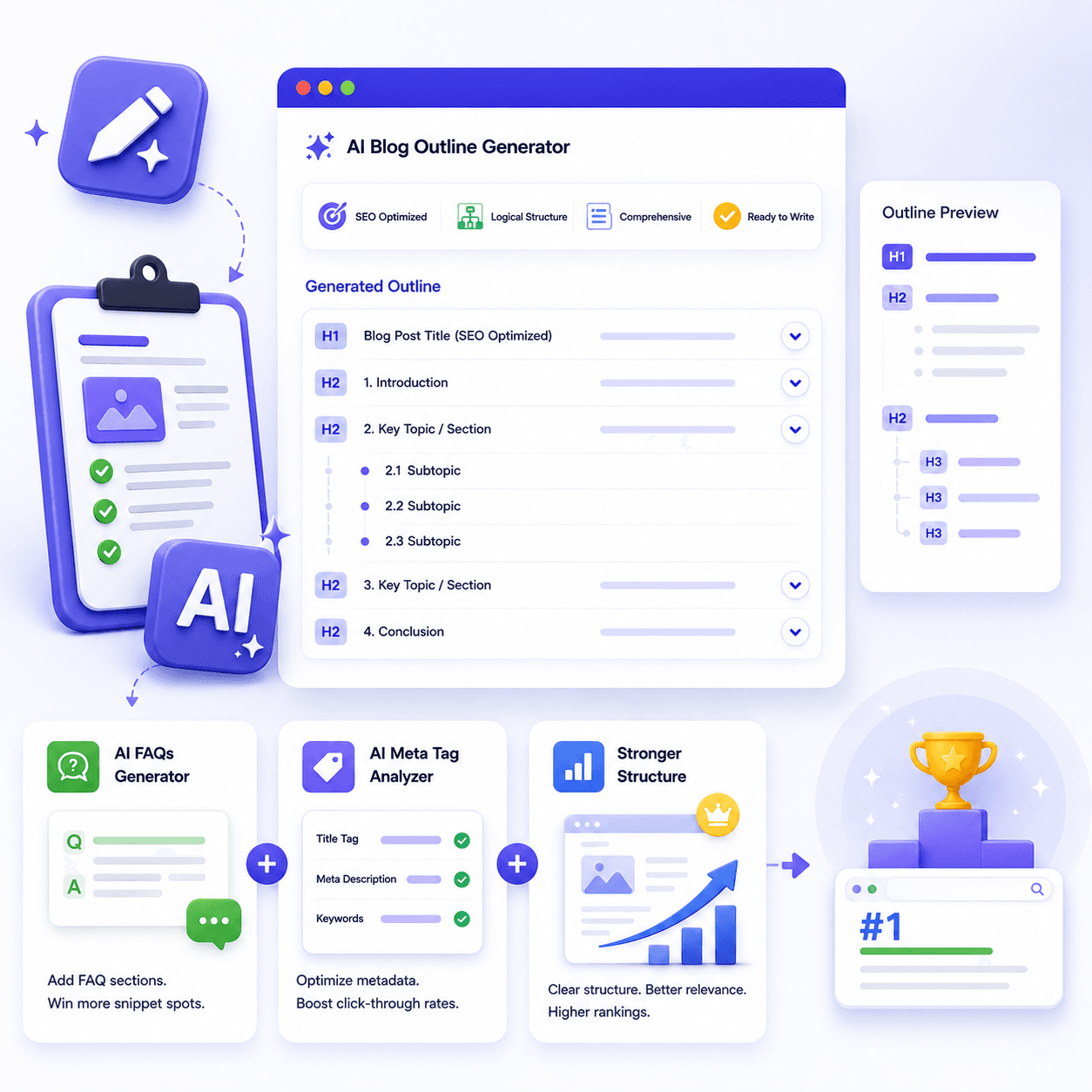
The AI blog outline generator gives every post on your site a fighting chance from the first draft. Use it alongside the AI FAQs Generator to build FAQ sections that capture additional snippet placements, and run your final metadata through the AI Meta Tag Analyzer before you hit publish.
Ready to Create High-Converting Blog Outlines?
Generate SEO-optimized, structured blog outlines for any topic in seconds with our free Blog Outline Generator.
Try the Blog Outline Generator Free